
EFT Tapping: What the Research Actually Shows
If you've landed here, there's a decent chance someone recommended tapping to you, or you saw it somewhere and thought: that looks a little strange — does it actually do anything? That's a fair question, and it deserves a real answer rather than either extreme you usually get: breathless enthusiasm on one side, or reflexive eye-rolling on the other.
Emotional Freedom Techniques (EFT), commonly called "tapping," involves lightly tapping on specific points on your face, chest, and hands while naming a specific worry or feeling out loud. It looks unusual. It also happens to be one of the more heavily studied self-help tools in psychology — with actual randomized controlled trials behind it, not just testimonials. This piece walks through what that research says, what's still genuinely uncertain, and how you might use it.
What tapping actually looks like
You don't need any special equipment or training to try a basic round. Here's the standard structure a therapist would walk you through:
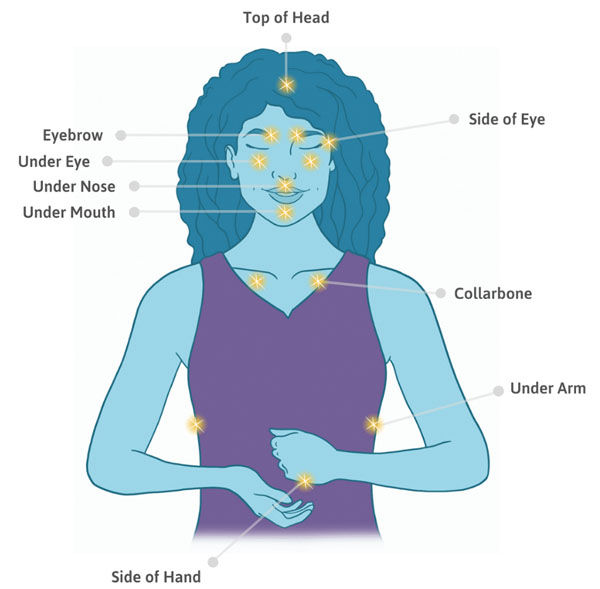
Name what's bothering you, specifically. Not "I'm stressed" in general, but something concrete — a work deadline, an argument, a memory that keeps surfacing. Rate how intense it feels right now on a scale of 0 to 10.
Say the setup phrase while tapping the side of your hand. Something like, "Even though I feel [specific thing], I deeply and completely accept myself." This pairs naming the problem with a small act of self-acceptance, rather than avoidance.
Tap through a set sequence of points — eyebrow, side of the eye, under the eye, under the nose, chin, collarbone, under the arm, top of the head — using two fingers, about seven taps per point, while repeating a short reminder phrase ("this stress," "this memory") at each stop.
Check the number again. Most people find it drops, sometimes only a little, sometimes a lot. You repeat the round, adjusting the language, until it settles.
A full round takes under two minutes. That's part of why it's spread so widely — it's low-effort to try and gives you real-time feedback.
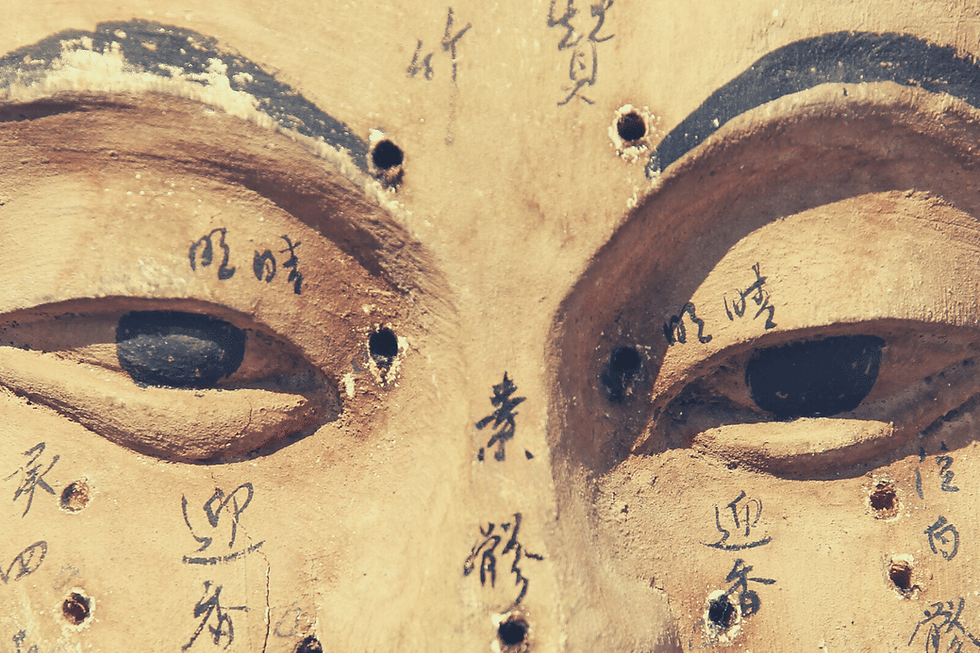
One honest note on where it comes from: this technique descends from a practice rooted in the idea that these points sit along the same energy meridians used in acupuncture. That origin is a big reason clinicians sometimes dismiss it before looking at the outcome data. But the theory behind why something might work and the evidence for whether it actually helps are two separate questions — and it's worth judging tapping on the second one.
What the studies actually found
This tends to surprise people, because EFT tapping research has quietly built up a real evidence base — including systematic reviews and meta-analyses, the same standard used to evaluate mainstream talk therapies.
For anxiety: A meta-analysis pooling 14 randomized controlled trials (658 participants total) found a large improvement in the tapping group — more than double the improvement seen in comparison groups that got no treatment or a different intervention.
For PTSD: A review pooling multiple controlled trials found large effects when tapping was compared against wait-lists or no treatment, and results roughly comparable to other well-established trauma therapies when compared head-to-head against them. In plain terms: it performed in the same range as therapies your clinician would already consider evidence-based, rather than dramatically outperforming or underperforming them.
On stress hormones, not just self-report: One of the more compelling studies put 83 people through a single hour-long session — either tapping, a supportive talk-therapy conversation, or no treatment — and measured cortisol (your primary stress hormone) in saliva before and after. The tapping group's cortisol dropped by about 24%, compared to roughly 14% in the other two groups, alongside measurable drops in self-reported anxiety and depression. A later, more tightly controlled replication found an even larger hormonal drop — though interestingly, the hormone change and how people said they felt didn't always move together, which is a useful reminder that feeling calmer and being biologically calmer aren't always the exact same thing.
Beyond general anxiety: Controlled studies have also looked at specific phobias (public speaking, small animals, flying), fear around childbirth, exam-related anxiety, and burnout in nurses during COVID-19, generally finding meaningful improvement. It's worth being honest that most individual studies are on the smaller side — often 30 to 90 people — so treat any single result as a data point, not a verdict.
So why would tapping on your face do anything?
This is the part researchers themselves haven't fully agreed on, and I think it's more useful to know that than to pretend there's a tidy answer.
Theory one: it's a compressed form of exposure therapy. Tapping borrows directly from cognitive behavioral therapy — you name a specific distressing memory or fear, stay with it instead of avoiding it, and pair it with a calming action, which is close to how exposure therapy works in more traditional treatment. Staying with something difficult, in small doses, while nothing bad happens, is one of the best-established mechanisms we have in all of clinical psychology.
Theory two: the tapping itself is doing something physiologically. A small brain-imaging study found changes in amygdala activity — the brain's threat-detection center — after a combined tapping-and-exposure session, alongside reduced fear symptoms. Other imaging work has reported similar patterns. This is genuinely interesting, but it comes from small studies, and "a scan showed a change" is a much more modest claim than "we've proven the mechanism." Treat this as promising, not proven.
Theory three: researchers have tried to isolate the two. The cleanest way to test whether tapping adds anything beyond the "just think about it and use a calming ritual" effect is to compare tapping on the correct points against tapping on the wrong points, or against no tapping at all. A meta-analysis designed specifically to test this found that acupoint stimulation does appear to add something real — not just a placebo ritual layered on top of exposure. That said, a 2025 research review looking across this entire body of work was careful to note that exactly how much credit belongs to the tapping versus the underlying exposure/reframing process is still an open question, and called for larger, more rigorous studies.
The honest takeaway: tapping is very likely doing at least two things at once — running a mini version of exposure therapy, and adding some form of physical, calming stimulation on top of it. Nobody has fully pinned down the exact split, and you should be a little skeptical of anyone who states the mechanism with total confidence in either direction.
What this means if you're thinking about trying it
It's a reasonable, low-risk tool for everyday stress, specific fears, and moderate anxiety. The strongest evidence sits in this range — not necessarily for complex or long-standing trauma, where working through it with a trained therapist tends to be better supported and safer than a self-help technique alone.
You probably don't need to get the exact points "right." If naming the specific worry and staying with it while calming your body is doing a lot of the work, the precision of the sequence likely matters less than actually being specific about what's bothering you and giving yourself a minute or two of real attention on it.
It's worth testing on something small before judging it. Pick a specific, moderate stressor — not your biggest one — rate it 0–10, try two or three rounds, and see if the number moves. That's a fair, low-stakes way to find out if this is a tool that works for you personally.
If it doesn't move the number, or the underlying issue feels bigger than a two-minute technique can touch, that's useful information too — and a good signal to bring it into a conversation with a therapist rather than something to work through entirely alone.
EFT Tapping: The Bottom line
Tapping has more real clinical research behind it than most things filed under "alternative wellness" — meaningful effect sizes for anxiety and PTSD, measurable drops in stress hormones, and early brain-imaging evidence that something more than expectation is happening. At the same time, the field hasn't fully settled on exactly why it works, and most studies are modestly sized. That combination — genuinely promising, not fully understood — is probably the most accurate way to think about it. It's a legitimate tool worth having in your kit, and, like most tools, it works best alongside support that can meet you where the two-minute version can't.



Comments